Valid Test CS0-003 Tutorial - Test CS0-003 Online
Wiki Article
What's more, part of that PrepPDF CS0-003 dumps now are free: https://drive.google.com/open?id=1KFPecnc52w83QbWwbFLsy3ouELz1G_YZ
Get the Most Recent CompTIA CS0-003 Exam Questions for Guaranteed Success: It would be really helpful to purchase CompTIA Cybersecurity Analyst (CySA+) Certification Exam (CS0-003) exam dumps right away. If you buy this CompTIA Certification Exams product right now, we'll provide you with up to 365 days of free updates for CompTIA Cybersecurity Analyst (CySA+) Certification Exam (CS0-003) authentic questions. You can prepare using these no-cost updates in accordance with the most recent test content changes provided by the CompTIA CS0-003 exam dumps.
CompTIA CS0-003 exam is an excellent way for IT professionals to validate their skills and knowledge in cybersecurity analysis. CompTIA Cybersecurity Analyst (CySA+) Certification Exam certification is recognized globally and is highly respected in the IT industry. CompTIA Cybersecurity Analyst (CySA+) Certification Exam certification provides a foundation for advanced cybersecurity certifications and helps IT professionals to advance their career in cybersecurity.
The CS0-003 Exam is designed to test the candidate’s ability to identify and analyze cybersecurity threats, assess the impact of those threats, and implement effective strategies to mitigate them. CS0-003 exam covers a wide range of topics including threat management, vulnerability management, incident response, security architecture and toolsets. It is a comprehensive exam that requires a thorough understanding of cybersecurity principles and practices.
>> Valid Test CS0-003 Tutorial <<
Test CS0-003 Online & CS0-003 Latest Exam Fee
Our CS0-003 practice test software contains multiple learning tools that will help you pass the CompTIA Cybersecurity Analyst (CySA+) Certification Exam in the first attempt. We provide actual CS0-003 questions copyright also for quick practice. Our CS0-003 vce products are easy to use, and you can simply turn things around by going through all the CompTIA Cybersecurity Analyst (CySA+) Certification Exam exam material to ensure your success in the exam. Our CS0-003 copyright will help you prepare for the CompTIA Cybersecurity Analyst (CySA+) Certification Exam even when you are at work.
CompTIA Cybersecurity Analyst (CySA+) Certification Exam Sample Questions (Q573-Q578):
NEW QUESTION # 573
An auditor is reviewing an evidence log associated with a cybercrime. The auditor notices that a gap exists between individuals who were responsible for holding onto and transferring the evidence between individuals responsible for the investigation. Which of the following best describes the evidence handling process that was not properly followed?
- A. Preservation
- B. Chain of custody
- C. Legal hold
- D. Validating data integrity
Answer: B
Explanation:
Comprehensive and Detailed Explanation:
The chain of custody is a documented history that tracks how evidence is handled, collected, transported, and preserved at every stage of the forensic investigation. If a gap exists in the record of who transferred or accessed the evidence, it could call into question the integrity and admissibility of the evidence.
* Validating data integrity (Option A) refers to ensuring that the forensic image is identical to the original data, often using cryptographic hashing, but it does not address procedural gaps in documentation.
* Preservation (Option B) involves protecting the original evidence from modification or loss but does not include logging transfers of custody.
* Legal hold (Option C) refers to a requirement to preserve data for legal proceedings, which is different from tracking evidence handling.
Thus, the correct answer is D, as chain of custody directly relates to tracking who had access to the evidence and when.
NEW QUESTION # 574
A security analyst is reviewing events that occurred during a possible compromise. The analyst obtains the following log: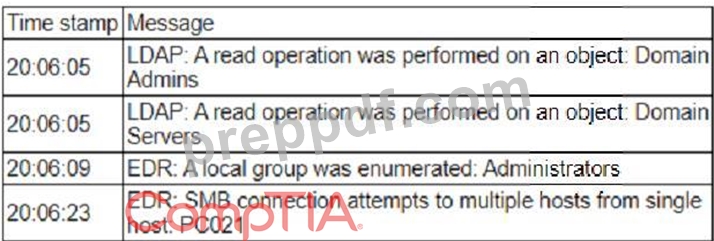
Which of the following is most likely occurring, based on the events in the log?
- A. An adversary is escalating privileges.
- B. An adversary is performing a password stuffing attack..
- C. An adversary is performing a vulnerability scan.
- D. An adversary is attempting to find the shortest path of compromise.
Answer: D
Explanation:
1. Analyze the Log Evidence: The log displays a specific sequence of rapid-fire events (within 18 seconds) characteristic of automated reconnaissance tools used to map Active Directory environments.
* 20:06:05 (LDAP Reads): The attacker queries the directory for high-value groups (Domain Admins) and critical infrastructure (Domain Servers). They are not trying to log in; they are reading the membership lists to see who is important and where the servers are.
* 20:06:09 (EDR Enumeration): The attacker checks the local Administrators group. This is to see if the current compromised user has admin rights or who does.
* 20:06:23 (SMB Connections): The host PC021 attempts to connect to multiple other hosts. This indicates the attacker is testing where they can move laterally using the credentials or access they currently have.
2. Why this is " Finding the Shortest Path " (Option A): This behavior is the textbook signature of tools like BloodHound (or its data collector, SharpHound).
* Concept: Adversaries use these tools to visualize relationships in Active Directory. They query LDAP to find out: " I am User A. Which computers can I access? Who is a Domain Admin? Is a Domain Admin logged into a computer I can access? "
* Goal: The tool calculates the mathematical " shortest path " (graph theory) from the attacker ' s current low-level foothold to the ultimate target (Domain Admin).
* The combination of LDAP querying (mapping the graph) and SMB connection attempts (verifying sessions/local admin rights) confirms the adversary is mapping out the network to find the most efficient route to total compromise.
Why the other options are incorrect:
* B. An adversary is performing a vulnerability scan: Vulnerability scanners (like Nessus or Qualys) typically probe ports and services to identify unpatched software (CVEs). They generally do not focus on querying LDAP for " Domain Admins " group membership as their primary action.
* C. An adversary is escalating privileges: While the attacker intends to escalate privileges eventually, the logs show enumeration (Discovery phase). They are currently looking for the path to escalate, not actively exploiting a vulnerability (like a kernel exploit) to change their privilege level in this specific snapshot.
* D. An adversary is performing a password stuffing attack: Password stuffing involves high volumes of failed authentication attempts against a login service. The logs here show read operations and connection attempts, not the " Invalid Credential " errors associated with stuffing.
NEW QUESTION # 575
A SIEM alert is triggered based on execution of a suspicious one-liner on two workstations in the organization's environment. An analyst views the details of these events below:
Which of the following statements best describes the intent of the attacker, based on this one-liner?
- A. Attacker is escalating privileges via JavaScript.
- B. Attacker is executing PowerShell script "AccessToken.psr.
- C. Attacker is utilizing custom malware to download an additional script.
- D. Attacker is attempting to install persistence mechanisms on the target machine.
Answer: C
Explanation:
The one-liner script is utilizing JavaScript to execute a PowerShell command that downloads and runs a script from an external source, indicating the use of custom malware to download an additional script. Reference: CompTIA CySA+ Study Guide: Exam CS0-003, 3rd Edition, Chapter 4: Security Operations and Monitoring, page 156.
NEW QUESTION # 576
A security analyst has prepared a vulnerability scan that contains all of the company's functional subnets.
During the initial scan, users reported that network printers began to print pages that contained unreadable text and icons.
Which of the following should the analyst do to ensure this behavior does not oocur during subsequent vulnerability scans?
- A. Ignore embedded web server ports.
- B. Perform non-credentialed scans.
- C. Increase the threshold length of the scan timeout.
- D. Create a tailored scan for the printer subnet.
Answer: D
Explanation:
The best way to prevent network printers from printing pages during a vulnerability scan is to create a tailored scan for the printer subnet that excludes the ports and services that trigger the printing behavior. The other options are not effective for this purpose: performing non-credentialed scans may not reduce the impact on the printers; ignoring embedded web server ports may not cover all the possible ports that cause printing; increasing the threshold length of the scan timeout may not prevent the printing from occurring.
References: According to the CompTIA CySA+ Study Guide: Exam CS0-003, 3rd Edition1, one of the objectives for the exam is to "use appropriate tools and methods to manage, prioritize and respond to attacks and vulnerabilities". The book also covers the usage and syntax of vulnerability scanning tools, such as Nessus, Nmap, and Qualys, in chapter 4. Specifically, it explains the meaning and function of each component in vulnerability scanning, such as credentialed vs. non-credentialed scans, port scanning, and scan scheduling1, pages 149-160. It also discusses the common issues and challenges of vulnerability scanning, such as network disruptions, false positives, and scan scope1, pages 161-162. Therefore, this is a reliable source to verify the answer to the question.
NEW QUESTION # 577
Which of the following most accurately describes the Cyber Kill Chain methodology?
- A. It provides a clear model of how an attacker generally operates during an intrusion and the actions to take at each stage
- B. It is used to ascertain lateral movements of an attacker, enabling the process to be stopped.
- C. It outlines a clear path for determining the relationships between the attacker, the technology used, and the target
- D. It is used to correlate events to ascertain the TTPs of an attacker.
Answer: A
Explanation:
The Cyber Kill Chain methodology provides a clear model of how an attacker generally operates during an intrusion and the actions to take at each stage. It is divided into seven stages:
reconnaissance, weaponization, delivery, exploitation, installation, command and control, and actions on objectives. It helps network defenders understand and prevent cyberattacks by identifying the attacker's objectives and tactics.
NEW QUESTION # 578
......
The only way to save yourself from this scenario is by relying on CompTIA CS0-003 study material. PrepPDF equips you with the excellent CompTIA CS0-003 dumps material to help you clear the CompTIA CS0-003 real examination on the maiden attempt. One of the leading factors of PrepPDF in this industry is offering only top-rated and updated CS0-003 Exams practice questions.
Test CS0-003 Online: https://www.preppdf.com/CompTIA/CS0-003-prepaway-exam-dumps.html
- New CS0-003 Test Objectives ???? Certification CS0-003 Exam Infor ???? CS0-003 Valid Study Questions ???? Download ➠ CS0-003 ???? for free by simply searching on ➽ www.examdiscuss.com ???? ????Certification CS0-003 Exam Infor
- 2026 Useful CS0-003: Valid Test CompTIA Cybersecurity Analyst (CySA+) Certification Exam Tutorial ✔ Easily obtain 《 CS0-003 》 for free download through { www.pdfvce.com } ????Pass CS0-003 Guide
- Score High in CS0-003 Exam with CompTIA's Exam Questions and Attain 100% Success ???? Download 【 CS0-003 】 for free by simply entering 【 www.prep4away.com 】 website ❇New CS0-003 Test Review
- CS0-003 Latest Practice Materials ???? Certification CS0-003 Questions ???? CS0-003 Valid Study Questions ???? Easily obtain ➤ CS0-003 ⮘ for free download through ➽ www.pdfvce.com ???? ????Latest CS0-003 Exam Pass4sure
- CS0-003 Upgrade Dumps ???? Valid CS0-003 Test Review ☃ Guaranteed CS0-003 Passing ???? Search for ▷ CS0-003 ◁ and download exam materials for free through ⇛ www.exam4labs.com ⇚ ????Latest CS0-003 Exam Pass4sure
- Valid Test CS0-003 Tutorial|Handy for CompTIA Cybersecurity Analyst (CySA+) Certification Exam ⛑ Easily obtain free download of [ CS0-003 ] by searching on ➠ www.pdfvce.com ???? ⏺Certification CS0-003 Questions
- www.troytecdumps.com: Your Reliable CompTIA CS0-003 Exam Companion ???? Open ▶ www.troytecdumps.com ◀ and search for ➽ CS0-003 ???? to download exam materials for free ????Valid CS0-003 Test Review
- CS0-003 Latest Dumps Files ???? Certification CS0-003 Questions ???? CS0-003 Valid Study Questions ???? Download ▶ CS0-003 ◀ for free by simply searching on “ www.pdfvce.com ” ????CS0-003 Upgrade Dumps
- CompTIA Cybersecurity Analyst (CySA+) Certification Exam exam study guide - CS0-003 exam prep material - CompTIA Cybersecurity Analyst (CySA+) Certification Exam latest exam simulator ???? Search for [ CS0-003 ] and download exam materials for free through 《 www.vceengine.com 》 ????Certification CS0-003 Exam Infor
- CS0-003 Latest Practice Materials ???? Exam CS0-003 Learning ???? Valid CS0-003 Test Review ???? Go to website ☀ www.pdfvce.com ️☀️ open and search for ➽ CS0-003 ???? to download for free ????Latest CS0-003 Exam Pass4sure
- Certification CS0-003 Exam Infor ???? Latest CS0-003 copyright Sheet ???? CS0-003 Valid Study Questions ???? Open website ⏩ www.testkingpass.com ⏪ and search for ⇛ CS0-003 ⇚ for free download ????CS0-003 Upgrade Dumps
- dianedqoq854543.bloggip.com, gregoryozos913768.blogspothub.com, www.stes.tyc.edu.tw, worldlistpro.com, cyruskrne244849.blogtov.com, directorydepo.com, www.stes.tyc.edu.tw, bookmarkssocial.com, gretacpkj532192.dgbloggers.com, www.stes.tyc.edu.tw, Disposable vapes
DOWNLOAD the newest PrepPDF CS0-003 copyright from Cloud Storage for free: https://drive.google.com/open?id=1KFPecnc52w83QbWwbFLsy3ouELz1G_YZ
Report this wiki page